Antimicrobial synthetic grass promises more than a neat, green surface. It may help limit microbial growth on treated fibers or infill, a useful consideration around pets, play areas, and busy sports fields. But product claims vary. The phrase “antimicrobial” does not, by itself, prove that a surface prevents illness or stays cleaner between maintenance visits.
What are the benefits of anti-microbial synthetic grass? The answer depends on the product’s test results, the organisms tested, and how the turf is cleaned. The U.S. Environmental Protection Agency explains that treated-article claims generally concern protecting the product itself; they should not imply public-health protection without appropriate authorization. CDC guidance also notes that cleaning with soap and water removes most germs from surfaces in many everyday situations. Antimicrobial treatment is an added feature, not a replacement for routine care.
Microbiologist Dr. Charles Gerba has studied how microbes persist on everyday surfaces. A practical takeaway from his hygiene research is this: “Antimicrobial treatment supports cleaning; it does not replace it.” That distinction matters when evaluating turf. A damp corner beneath a water bowl, or debris packed between blades, still needs attention.
These seven tips will examine potential benefits, testing evidence, maintenance, and realistic limitations. The details matter. A promising claim deserves careful questions before purchase.
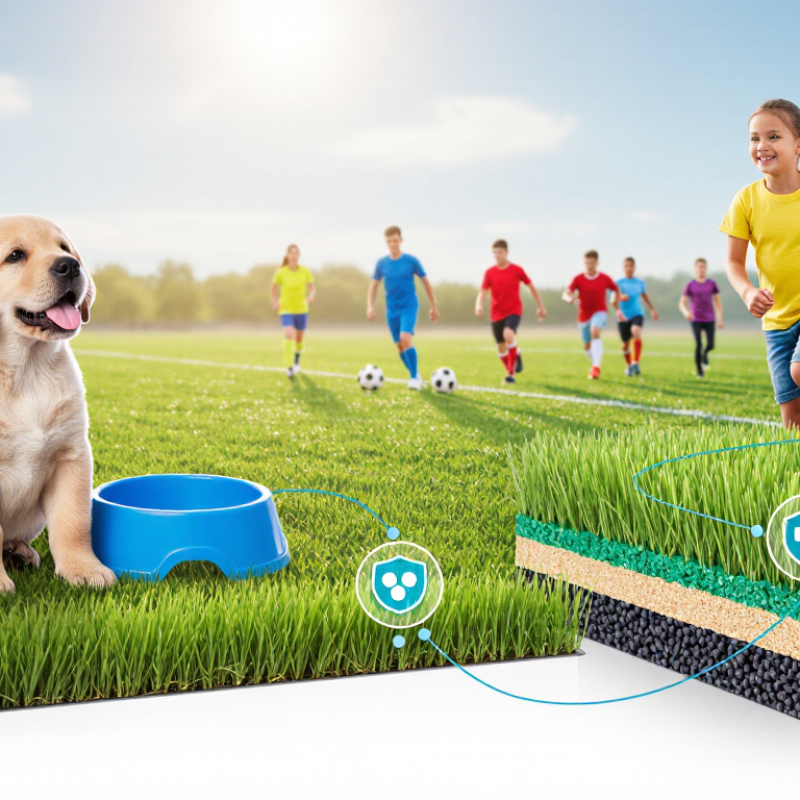
Antimicrobial synthetic grass is a layered system, not a single treated surface. The fibers are usually polymer strands; antimicrobial additives may be blended into the polymer or applied as a coating. Infill can contain treated mineral or polymer particles, while the backing may use an antimicrobial additive to limit growth on its underside. These options are not interchangeable. A coating can wear, and infill can collect dust, skin cells, and moisture. Real maintenance still matters.
Ask what each layer contains and request test results for the finished material, not just the additive. ISO 22196:2011 measures antibacterial activity on non-porous surfaces after 24 hours of controlled contact. That is a lab test, not a prediction of field performance. It does not recreate muddy cleats, sun exposure, cleaning, or years of foot traffic. ASTM E2149 also evaluates antimicrobial activity under dynamic contact conditions, offering a different test approach. Neither result means the turf is sterile. Look for the tested organisms, methods, and reported reductions, plus details on drainage and cleaning. Small gaps in the evidence matter. A product can test well and still need routine care.
What the chart shows: Antimicrobial additives may be incorporated into turf fibers, applied to infill, or used in backing materials. These are potential treatment locations—not a measure of antimicrobial effectiveness, and not a claim that every product contains such additives. Formulations vary; antimicrobial treatments do not replace routine cleaning.
ISO 22196 provides a controlled way to assess antibacterial activity on non-porous surfaces. A laboratory places a measured bacterial suspension on the sample and a control surface, then covers each with a thin film. Both are held at about 35°C for 24 hours before viable bacteria are counted. The difference helps show whether the tested surface reduced bacterial numbers under those conditions.
The setup matters. Synthetic grass has raised fibers, seams, and backing, so the lab should explain which parts were tested and how samples were prepared. Ask for the test date, bacterial strains, control results, and measured reduction—not just a broad “antibacterial” claim. Small details can change what a result means.
Not a sterilization test. A strong laboratory result does not show that a lawn stays bacteria-free outdoors, where rain, dirt, sunlight, and foot traffic alter the surface. Nor does it automatically predict odor control or long-term performance. I would read the report carefully and remain a little cautious: a 24-hour test is useful evidence, but it is only one snapshot of a much messier setting.
Antimicrobial synthetic grass is designed to make its surface less hospitable to certain microbes. Some additives may slow bacterial growth on fibers, but they cannot sterilize turf or stop every organism. That distinction matters. Odors often come from urine, food spills, and damp debris trapped below the blades, not from surface bacteria alone. After a warm afternoon, a wet patch may still smell if drainage is poor.
A practical cleaning routine still does much of the work. Rinse pet areas, remove leaves, and brush flattened blades so air can move through the pile. Check that the base drains instead of holding water. Antimicrobial properties may help limit bacterial buildup between cleanings, but results vary with turf design, installation, and use. Ask for test data showing which organisms were tested, how testing was done, and for how long. Broad claims can be hard to judge. For households with children or pets, follow care instructions rather than assuming treated fibers replace routine cleaning. Even good turf can hold grime. That is easy to overlook.
An “antimicrobial” label is not proof that synthetic grass protects people from infection. Under FIFRA, products making public-health pesticide claims generally need EPA registration. EPA reviews the product’s proposed uses, evidence, risks, and label directions. A narrower exception may apply when treatment protects the article itself, not people; claims must stay within that scope. Check the EPA Pesticide Product and Label System for registration and label details. Registration is not a blanket endorsement, and it does not support claims beyond the approved label. Small wording matters.
Tip: Read the exact claim. “Helps protect the turf material” differs from “kills disease-causing bacteria.” Ask the seller for the EPA registration number, the approved label, and test data for the specific grass surface. EPA’s FIFRA guidance and label database are useful references; independent test reports should identify the test method, organism, contact time, and conditions. A lab result on a wet sample may not match a dusty, sun-heated play area.
For practical evaluation, look for evidence tied to real use: repeated cleaning, outdoor exposure, and the surface’s wear. Industry testing standards can help compare methods, but no single test proves lasting protection in every installation. Avoid broad health promises when the documentation only shows material preservation. And keep expectations modest. Maintenance still matters.
Antimicrobial synthetic grass claims are only useful when the supporting evidence is clear. Ask for a test report naming the turf material, organisms tested, laboratory, test method, and contact time. A result for one surface or organism does not automatically apply to every installation. Check whether the sample was tested clean, after wear, or after exposure to sunlight and moisture. Those details matter.
Look for results from a qualified, independent laboratory, with untreated material or another suitable control for comparison. The report should state how much microbial growth changed and under what conditions. “Antimicrobial” does not mean sterile, and it does not replace cleaning or handwashing. That distinction is easy to miss. If a seller provides only a broad claim or an undated certificate, request the complete report before relying on it.
Maintenance records help show whether claimed performance is being preserved in real use. Keep dated notes on brushing, debris removal, rinsing, and any approved cleaning products. Record heavy use, spills, standing water, and repairs, too. A simple log can reveal that a neglected corner smells or drains poorly despite reassuring test data. It is not perfect evidence: cleaning routines vary, and site conditions change. Compare records with the test report, and ask whether testing reflects the turf’s actual age and care.
It usually has polymer fibers, infill, and backing. Additives may be mixed into or applied to different layers.
No. Antimicrobial treatment does not mean sterile, and it cannot replace regular cleaning.
Look for the tested turf material, organisms, laboratory, method, contact time, and measured change in microbial growth.
No. Mud, sunlight, moisture, dust, and foot traffic can change performance. Real conditions are messy.
Ask what the treatment is intended to protect and request supporting documentation for that exact surface.
Note brushing, debris removal, rinsing, spills, standing water, repairs, and approved cleaning products.
Not automatically. Results depend on the material, organism, test conditions, wear, and exposure tested.
It can flag a smelly corner or poor drainage, even when test data looks reassuring. Logs are imperfect, too.
What are the benefits of anti-microbial synthetic grass? Depending on its materials and test results, antimicrobial turf may help limit bacterial growth on treated surfaces and reduce odors associated with dampness, pets, or frequent use. Its performance can depend on where the antimicrobial treatment is applied—within the fibers, infill, or backing—and how the turf is installed and maintained. These features complement, rather than replace, regular cleaning and good drainage.
ISO 22196 evaluates antibacterial activity under specified laboratory conditions, including a 24-hour test period at 35°C; results should be reviewed to understand what was tested and how closely the method reflects real-world use. In the United States, EPA FIFRA registration may be relevant to certain antimicrobial claims, so product statements should be checked for appropriate support. Buyers can verify claimed benefits by reviewing test data, treatment details, and maintenance records, while recognizing that results may vary with use and care.
Purely Plants